AI Workforce in India: How Organisations Can Prepare for the Future of Work
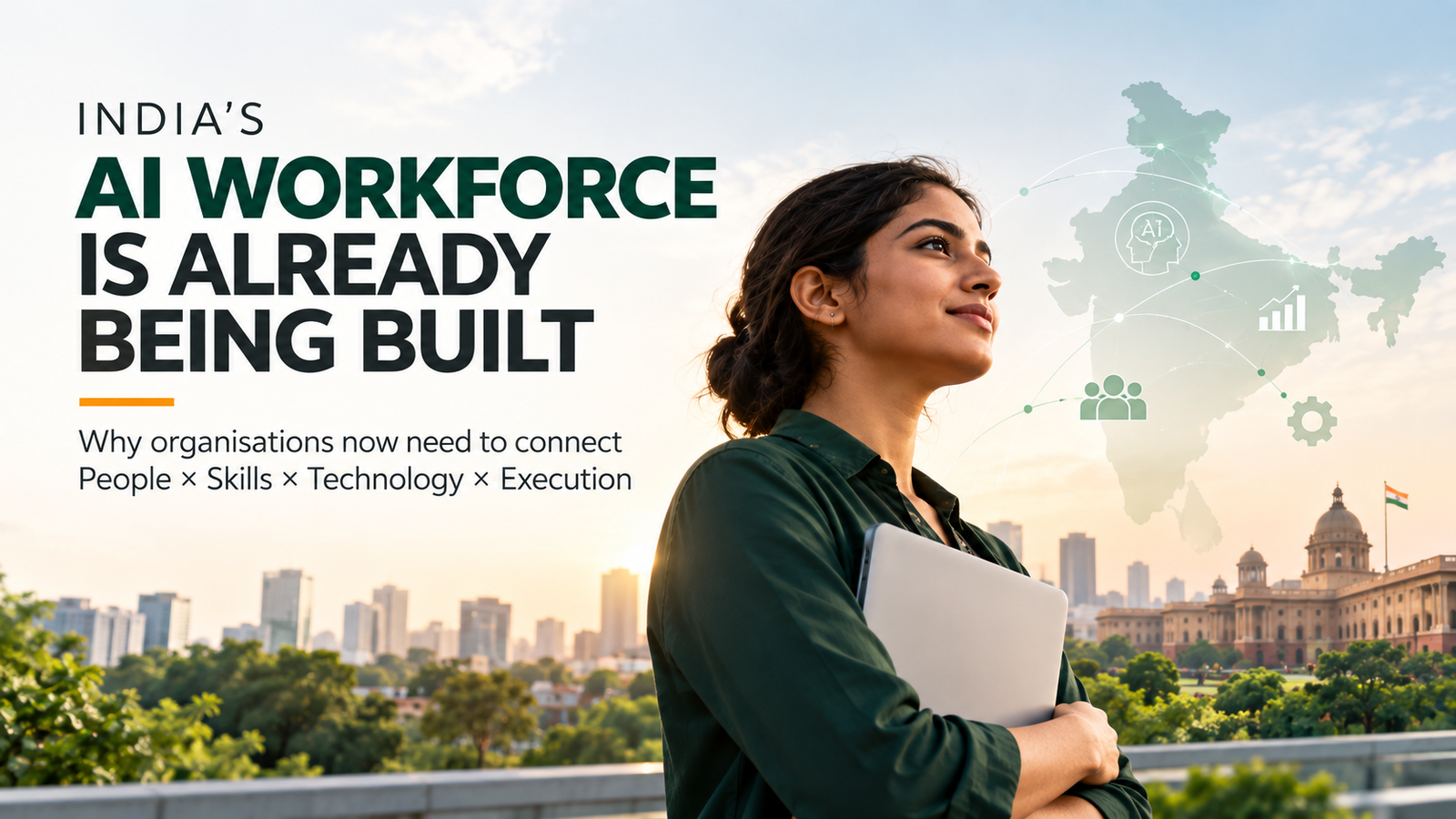
India’s AI workforce is already being built. Government skilling programmes, digital transformation initiatives and the growing adoption of artificial intelligence are changing what it means to be a future-ready employee.
The important question for organisations is no longer simply whether AI will change the workplace.
It is:
How can organisations prepare their workforce for an AI-enabled future?
India is increasingly investing in AI skills, digital skills, workforce development and future-ready training. For businesses, government institutions and other organisations, this creates both an opportunity and an execution challenge.
At Petiole, we believe the next phase of workforce transformation will depend on connecting people, skills, technology and execution.
India’s AI Workforce Is Growing
The scale of India's AI-skilling ecosystem provides an important indication of the direction of the country's workforce.
According to the Ministry of Skill Development and Entrepreneurship, as of 6 August 2026, the Government's Skilling for AI Readiness (SOAR) programme had recorded:
-
5,17,477 learner enrolments
-
1,00,664 certifications
-
50 AI and AI-application-oriented courses available through the Skill India Digital Hub
At the same time, PMKVY 4.0 has expanded its focus towards future and emerging skills.
As of 30 June 2026, more than 5.44 lakh candidates had been trained or oriented in future-skill roles under PMKVY 4.0, with more than 3.73 lakh candidates certified.
The areas covered include:
-
Artificial Intelligence
-
Machine Learning
-
Data Science
-
Cybersecurity
-
Cloud Computing
-
Robotics
-
Internet of Things (IoT)
-
Drones
-
Semiconductors
-
Other emerging technologies
These developments indicate that AI and digital skills are becoming an increasingly important part of India's workforce development agenda.
What Is an AI-Ready Workforce?
An AI-ready workforce does not mean that every employee needs to become an artificial intelligence engineer.
Instead, it means employees understand how AI can be used within their roles and how to use it effectively, responsibly and productively.
An AI-ready employee may be able to use AI tools for:
-
Research and information analysis
-
Document preparation
-
Data interpretation
-
Report generation
-
Administrative workflows
-
Communication
-
Knowledge management
-
Customer support
-
Operational monitoring
-
Decision-support activities
The depth of AI capability will differ by role.
A technical professional may require advanced AI and machine-learning skills.
A manager may need AI-assisted analytics and decision-support capabilities.
A field employee may benefit from AI-enabled reporting and documentation.
A government employee may require AI literacy alongside strong data protection and verification practices.
This makes role-based AI training increasingly important.
From Digital Transformation to AI-Enabled Workforce Transformation
For many years, organisations treated technology implementation and employee training as separate initiatives.
AI is changing this model.
An organisation can purchase an advanced AI platform, but the technology alone does not guarantee productivity.
The real value emerges when technology is integrated with:
People + Skills + Processes + Governance
This creates a simple framework for organisations:
PEOPLE × SKILLS × TECHNOLOGY
Technology provides capability.
Skills provide the ability to use it.
People provide judgement, context and accountability.
Processes connect these elements to actual business outcomes.
Why AI Training Alone Is Not Enough
One of the biggest challenges in AI adoption is the gap between learning about AI and applying AI.
A person may complete an AI course and receive a certificate.
But organisations ultimately need to know:
What can that person now do better?
A stronger workforce-development model therefore looks like:
Training → Application → Workflow Integration → Measurement → Improvement
For example, an employee may previously have spent several hours manually preparing a report.
With appropriate AI training and workflow redesign, the employee could potentially use AI-assisted tools to:
-
Structure large amounts of information
-
Identify relevant patterns
-
Prepare an initial report
-
Generate supporting visuals
-
Verify the information
-
Produce the final human-reviewed output
The objective is not to remove human judgement.
It is to augment human capability.
AI in Government and Public-Sector Work
The potential impact of AI is particularly significant for India's public sector.
Government departments and public institutions manage substantial volumes of:
-
Administrative records
-
Applications
-
Reports
-
Field information
-
Correspondence
-
Data
-
Documentation
-
Operational information
AI can potentially assist with many information-intensive activities.
However, government AI adoption requires strong safeguards around:
Accuracy | Data Protection | Human Oversight | Accountability | Responsible Use
Government initiatives indicate that AI adoption is already moving beyond experimentation.
According to Government of India information released in 2026, 762 AI use cases had been identified across 62 Ministries and Departments, while approval had been provided for 543 Data & AI Labs in ITIs and polytechnics.
This illustrates an important trend:
AI capability is increasingly becoming an institutional capability, not simply an individual technical skill.
The Future of Work in India Will Be Human + AI
The debate around AI and employment is often framed as:
Will AI replace people?
For organisations, a more practical question is:
How will AI change what people do?
Many roles contain repetitive, administrative or information-intensive activities.
AI can potentially assist with these tasks while allowing employees to focus more heavily on:
-
Judgement
-
Communication
-
Problem solving
-
Relationship management
-
Creativity
-
Decision-making
-
Field execution
-
Accountability
This suggests that the future of work may increasingly be characterised by human-AI collaboration.
The organisations that benefit from this transition will need to invest not only in technology but also in workforce capability and process redesign.
Five Priorities for Building an AI-Ready Workforce
1. Identify AI Skill Gaps
Organisations should first understand where AI capability is required.
Not every employee needs the same level of training.
Map capabilities according to:
Role → Workflow → Skill → AI Application
2. Provide Role-Based AI Training
Generic AI awareness programmes can create familiarity.
Role-based training can create application.
Training should therefore reflect actual workplace requirements.
For example:
HR teams: recruitment, documentation and workforce analytics
Finance teams: analysis, reporting and reconciliation support
Operations teams: monitoring, reporting and workflow optimisation
Government teams: documentation, analysis and information management
3. Redesign Workflows
AI should not simply be added to an inefficient process.
Organisations should identify where technology can genuinely improve:
-
Turnaround time
-
Accuracy
-
Reporting
-
Documentation
-
Monitoring
-
Analysis
-
Decision support
The objective should be workflow transformation, not tool adoption.
4. Establish Responsible AI Practices
AI adoption requires governance.
Organisations should establish clear guidelines covering:
-
Confidential information
-
Personal data
-
Sensitive documents
-
Human verification
-
Output accuracy
-
Acceptable use
-
Escalation procedures
Responsible AI adoption is especially important for organisations handling government, employee, citizen or customer information.
5. Measure Business Outcomes
AI adoption should ultimately be measurable.
Instead of asking:
“Are employees using AI?”
organisations should ask:
“What improved because employees started using AI?”
Possible measures include:
-
Reduced processing time
-
Improved reporting quality
-
Faster documentation
-
Reduced repetitive work
-
Improved analytical capability
-
Better employee productivity
This shifts the conversation from AI adoption to AI-enabled productivity.
India's Opportunity: Connecting Skills With Execution
India has a significant opportunity to combine its workforce scale with its digital and technology capabilities.
The Government's skilling ecosystem is increasingly focused on connecting skills, employment, entrepreneurship and emerging technologies.
The Economic Survey 2025–26 also highlights the importance of strengthening the connection between skilling systems, employers and labour-market requirements.
The next challenge is therefore not simply increasing the number of people who receive training.
It is ensuring that training translates into productive capability.
The more meaningful question is:
What are trained workers able to accomplish after training that they could not accomplish before?
That is where workforce development becomes an economic productivity issue.
Petiole’s Perspective on AI and Workforce Transformation
At Petiole Expert Solutions, we see the future of workforce transformation at the intersection of:
People × Skills × Technology × Execution
AI provides new capabilities.
Training enables people to use those capabilities.
Process redesign connects technology to actual work.
Execution converts these capabilities into measurable outcomes.
Our approach is therefore centred on building workforce and organisational capability rather than treating technology adoption as an isolated IT project.
For government institutions, enterprises and organisations managing large operational programmes, the opportunity lies in bringing together:
Workforce Management + Training + Digital Capability + Monitoring + Execution
This is the direction in which we believe modern consulting and workforce solutions are evolving.
What Organisations Should Do Next
Organisations preparing for an AI-enabled workplace can begin with five practical questions:
1. Which jobs will be most affected by AI?
2. Which employees require AI literacy or advanced AI skills?
3. Which existing workflows can benefit from AI?
4. What governance is required to use AI responsibly?
5. How will productivity improvements be measured?
The answers can form the foundation of an organisation's AI workforce strategy.
Conclusion: India’s AI Workforce Is Being Built Today
India's AI transformation is not a distant possibility.
The workforce ecosystem is already adapting.
Government skilling programmes are expanding AI and future-skill training. Institutions are exploring AI applications. Organisations are beginning to integrate AI into everyday workflows.
The next stage will be about execution.
The organisations that successfully navigate this transition will need to connect:
Technology with people.
Training with application.
Skills with employment.
AI with workflows.
Innovation with measurable outcomes.
At Petiole, we believe India's next phase of workforce transformation will be defined not merely by how many people learn about AI, but by how effectively organisations enable people to use AI to create measurable value.
About Petiole
Petiole Expert Solutions Private Limited is an India-focused consulting and execution organisation working across workforce solutions, government projects, training and capacity building, technology-enabled services, monitoring and operational execution.
Our focus is to help organisations connect strategy with execution and technology with people.
Petiole — Consulting • Workforce • Skilling • Technology • Execution
Sources
-
Ministry of Skill Development & Entrepreneurship / Press Information Bureau — SOAR and PMKVY 4.0 updates
-
Government of India — Economic Survey 2025–26
-
Ministry of Electronics & Information Technology / IndiaAI Mission — AI adoption and public-sector AI initiatives
Statistics in this article refer to the dates specified by the respective Government sources and are not intended to represent real-time programme totals.